
In what is seen as a significant move, the DAP featured measures to reduce delay in procurement of essential items by the three services as it proposed a new enabling provision to acquire them through capital budget under a simplified procedure in a time-bound manner.

Key discussions focused on major defence procurements, including India's plan to acquire six additional P-8I aircraft for anti-submarine warfare. The deal, estimated at around Rs 30,000 crore, is under advanced negotiations.

'The share of the private sector is at its all-time high of around Rs 42,000 crore in FY26, reflecting its expanding role in the defence ecosystem.'
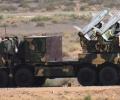
India's defence sector is on the cusp of a 'super cycle' of growth, driven by escalating geopolitical conflicts and a strong policy push towards indigenous manufacturing, with major players like BEL, HAL, and BDL poised for significant order inflows and technological advancements.

The Defence Acquisition Council (DAC) has recently approved procurement proposals worth Rs 79,000 crore across three services and it has cleared AoN (Acceptance of Necessity) of Rs 3.3 trillion in financial year 2026 (FY26).

History may remember Takaichi Sanae not as the leader who simply accelerated Japanese rearmament, but as one who governed during Japan's transition from an industrial-age security model to a post-industrial strategic member of the global order, points out Varun Arya.
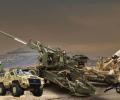
'India has the capital to invest in defence production.' 'With clear timelines and commitments, private industry can deliver surge capacity effectively.'
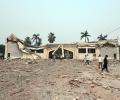
'We won not (only) because we were able to carry out long-range precision strikes.' 'That is, of course, one of the reasons but we had better situational awareness about what's happening than Pakistan.'
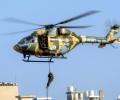
'The tools of warfare are changing. The MoD must deepen its engagement with technology thinkers that can present compelling visions of where warfare may be heading.'
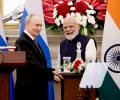
Russia, being bogged down by the Ukraine war and prioritising the requirements of its own armed forces, along with India's consistent diversification policy, will remain a major challenge to the bilateral partnership, note Harsh V Pant and Aleksei Zakharov.

'Currently, it takes between two and three years to formulate the request for proposal for procuring specific military equipment for the armed forces. It should not be this way.'

Its 'failure not just affects the military's effectiveness but could also be politically vulnerable for the BJP,' observes Ajai Shukla.

The conflict may disrupt Budget 2026-2027 projections, squeezing revenues and raising subsidies, prompting fiscal adjustments and potential reforms, echoing lessons from the Covid-era shock, points out A K Bhattacharya.
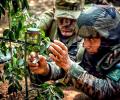
The Defence Research and Development Organisation (DRDO) has transferred seven technologies developed under the Technology Development Fund (TDF) scheme to the armed forces, enhancing indigenous defense capabilities.

With Army Chief Gen V K Singh highlighting shortage of equipment, the defence ministry on Monday appeared to be fast-tracking decision-making as it approved a plan for development of capabilities and effected a major change in offset policy by including transfer-of-technology.
'Make-in-India played a key role in India's effective action against terrorism during Operation Sindoor.'
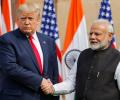
The China threat continues to resonate in the strategic partnership between India and the USA, points out Rup Narayan Das.
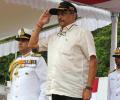
His background as an Indian Institute of Technology graduate and as a chief minister with an excellent track record as an administrator equipped him to initiate defence industry and policy reforms that are only now beginning to bear fruit.

Minister of State for Defence Ajay Bhatt said the major defence equipment that were imported included helicopters, aircraft radars, rockets, guns, assault rifles, missiles and ammunition.

Seen as a major initiative, the 'strategic partnership model' aims to create a vibrant defence manufacturing ecosystem in the country through involvement of both the major Indian corporates as well as the MSME sector.
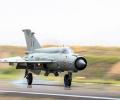
The MiG-21 episode demonstrates that procurement is always strategic.
Choices about what aircraft to acquire, who builds them, who supplies the spares, who trains the pilots and technicians are decisions with political consequences lasting for decades.
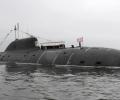
Admiral describes it as 'a path-breaking change'; defence ministry official disagrees.

Access to India's defence market must be made conditional -- available only to those who are ready to make a long-term commitment in India, argues Ajai Shukla.
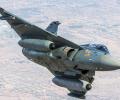
HAL's order book amounts to Rs 2.45 trillion by end of Q2FY26, implying a book-to-bill ratio of 32 times based on FY25 revenue.
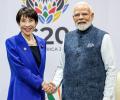
If they act now, they can reshape the strategic map of Asia without firing a shot. If they wait, the next opportunity will come only after a serious Taiwan Strait incident -- by which time the price will be far higher, and the room for boldness far smaller -- the opportunity may well be lost by then. The question is no longer whether this can or should be done, points out Varun Arya.

It is baffling how the PM chose the LCH as an indigenous product to celebrate on Rashtriya Raksha Samarpan Parv, even while his Cabinet holds up manufacturing clearance for 15 LCHs on the grounds that they are not Indian enough.

Posing a series of questions to the prime minister, Congress general secretary in-charge communications Jairam Ramesh also asked if Modi would convey to the US president that India would send its own aircraft -- like Venezuela and Colombia did -- to bring back Indian deportees in the future.
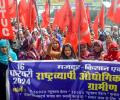
Over 25 crore workers across India are set to strike against new labour codes and privatisation, potentially disrupting banking, postal, and other essential services.

A Rs 23,000-crore production-linked incentive (PLI) scheme for electronic components may boost margins and enable a broader product mix.

The approved proposals included "procurement of night sight (image intensifier), light vehicles GS 4X4, air defence fire control radar (light) and GSAT-7B satellite," it mentioned.

In a year bookended by intractable conflicts and geopolitical fragmentation, India focused on ramping up military prowess by broadly firming up defence procurement worth Rs 4.22 lakh crore even as Indian and Chinese militaries completed pulling back their troops from border face-off points in eastern Ladakh.

'With the new DPP, there will be greater transparency and faster clearances.'

In a double-dose bid to boost growth and employment prospects, the Union Cabinet on Tuesday approved a Rs 2.07 trillion outlay for a research development and innovation (RDI) Scheme to fund private sector innovations, and an employment-linked incentive (ELI) to create over 35 million new jobs over the next two years.

In 2020 India was compelled by China to change its national security strategy. From counter-insurgency, which the army has been focussed on for years, we shifted to conventional war, observes Aakar Patel.

An expert committee has recommended to Defence Minister Manohar Parrikar that supply of equipment need not be blocked even if bribery charges emerge.
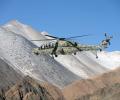
The ministry also decided to dispense with the requirement of the Integrity Pact Bank Guarantee to reduce the financial burden on the Indian defence industry, a move aimed at promoting domestic manufacturing.

It said the acceptance of necessity accorded to the procurement by the Defence Acquisition Council noted the estimated cost of $3,072 million as provided by the US government, adding the price will be negotiated once policy approval from Washington is received.

"The amended second draft (known as DAP) has since been finalised by the review committee driven by tenets of defence reforms announced as part of the 'Atmanirbhar Bharat Abhiyan' and has been placed in the public domain," the ministry said.

During the talks, India and the US decided to take a big leap in broad-basing their strategic ties in several critical areas.
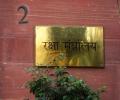
The defence ministry will review all cases of blacklisted firms as it prepares a new list of such entities following the new policy unveiled by it which is a mixture of heavy fines and graded banning.
